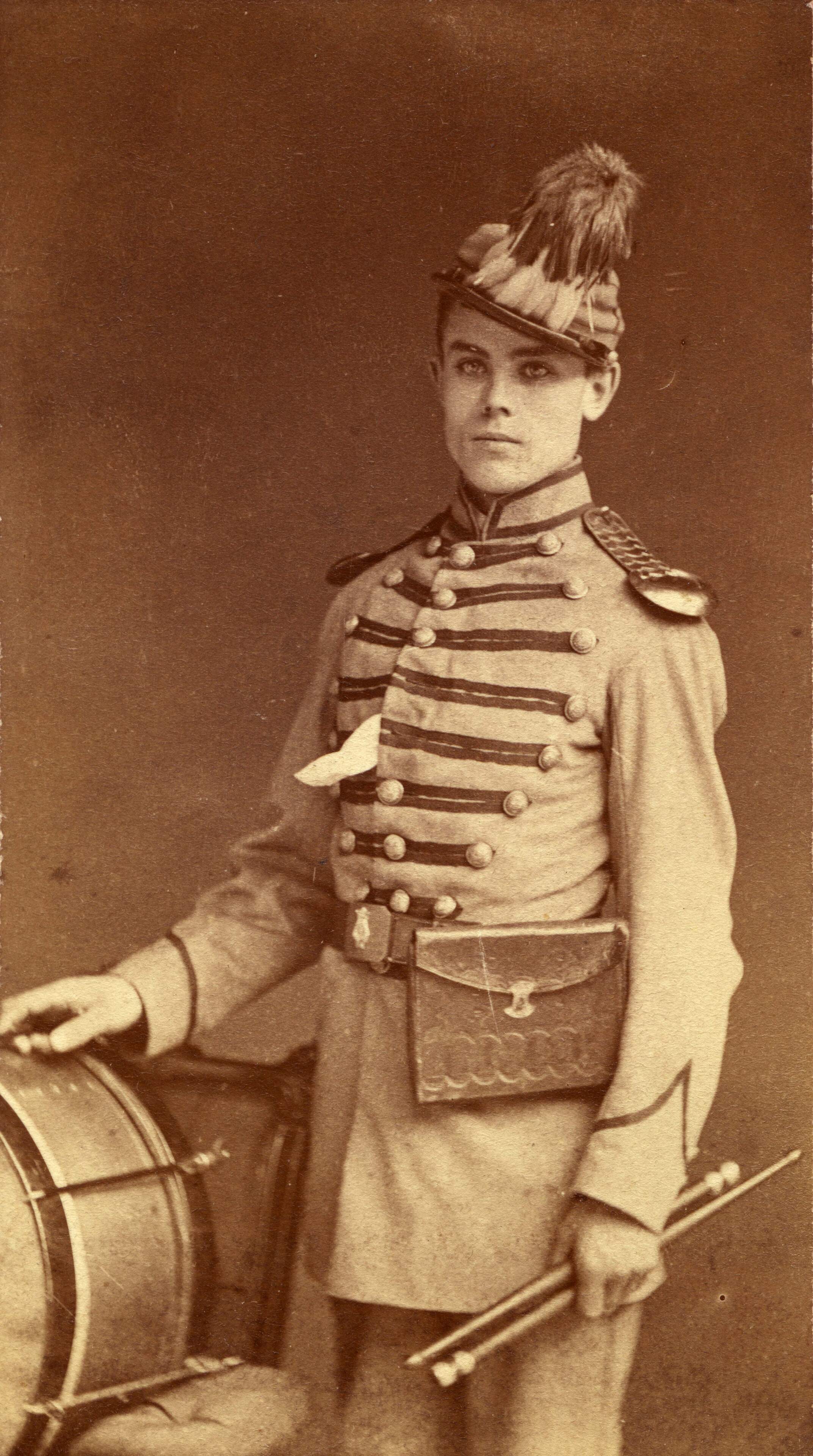
Frank B. Clench (b. Niagara, Canada 1838-1914)Portrait of a Civil War Drummer
around 1863
Albumen print, Carte-de-visite, produced in Lockport, N.Y.
3 7/8 x 2 1/8 inches on 4 3/16 x 2 ½ tan card stock
Burchfield Penney Art Center, Gift of Howard and Carole Tanenbaum, 2016
The drummer in this carte-de-visite is wearing the Union uniform of Lockport troops enlisted during the Civil War.
Carte-de-visite, originally, was a calling card, especially one with a photographic portrait mounted on it. Immensely popular in the mid-19th century, the carte-de-visite was touted by the Parisian portrait photographer André-Adolphe-Eugène Disdéri, who patented the method in 1854. Disdéri used a four-lensed camera, which made eight 3.5 × 2.5-inch (8.89 × 6.35-cm) negatives on one full-sized plate. The large print made from that plate was cut up into small portraits, which were separately mounted on cards measuring about 4 × 3 inches (10 × 7.6 cm). These cards were inexpensive relative to other forms of portraiture, as eight different poses could be made at one sitting and the images required no retouching.
Cartes-de-visite became a fad and were commonly exchanged on birthdays and holidays; the carte-de-visite album became a common feature of Victorian parlours in Europe and the United States. During the American Civil War, Mathew B. Brady and other photographers did a booming business in them in Washington, D.C., and New York City. The fashion for cartes-de-visite peaked in the 1860s. The cartes of celebrities and royalty remain collectors’ items.
Resource: https://www.britannica.com/technology/carte-de-visite