Charles E. Burchfield (1893-1967)Spider and Grasshoppers
1948-63 (unfinished)
Watercolor on joined paper mounted on board
44 x 34 inches
Burchfield Penney Art Center, Gift of the Burchfield Foundation, 1974
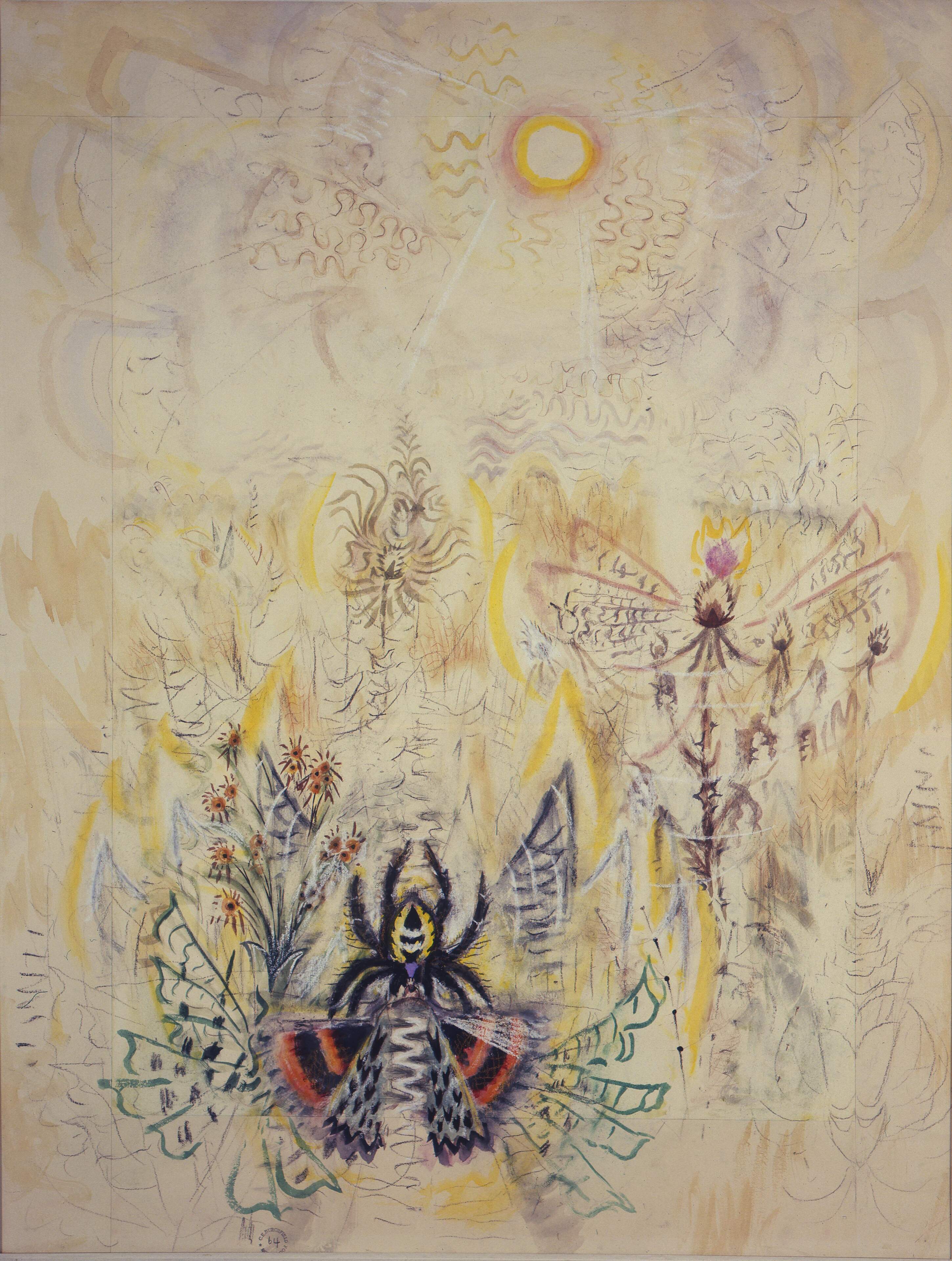
On August 24, 1948, Burchfield wrote in his journal that he had gone to Zimmerman Road “to do the grasshopper picture” and it was an “ideal day for it – hot, dry, the air full of insect sounds.” He located a site "on the edge of the swampy pasture at the north side of the woods…ate lunch...” and then spent "All afternoon on the painting—unpremeditated was the introduction of a yellow and black spider (Miranda) feeding on a grasshopper. I found it to be an ideal way of working — i.e. on one day to work out the conventionalizations & abstract motifs, then the next to work on the spot, so as to give life to the forms invented. I worked boldly & with great absorption." After having exhibited the painting at the Rehn Galleries, Burchfield later decided to make changes. He added paper, washed away images of grasshoppers, enlarged the Golden Orb Weaver Spider capturing a Sweetheart Underwing, and sketched a more fantastic, sun-drenched field environment. — Nancy Weekly
Burchfield's later masterworks are highly complex watercolors often composed of multiple sheets of paper. They often took years to complete. Spider and Grasshoppers is a revealing, instructive example of a work in progress. Considered a finished, signed and dated work in 1948, it was exhibited in New York at the Frank K. M. Rehn Galleries. Burchfield remounted and enlarged the 34½ by 25½-inch painting on August 24, 1963, with the intent to change it "considerably." On each of the four sides he added border strips measuring approximately four to five inches in width. He scrubbed out the grasshoppers that had featured prominently in the original painting. Small sections of the paper are visibly roughened by the abrasive actions.
What had been an airy, unfocused composition was well on its way to becoming a formidable image of a golden orb weaver spider (Miranda) eating a sweetheart underwing (also known as scarlet underwing) snared in a much larger web. Wildflowers, such as fleabane and thistles, were lightly painted in the middle ground with medium toned greens, pinks, and browns where scarcely defined grass had been before. The magnified imagery was already beginning to be edged with cadmium yellow flame shapes. A parching summer sun was placed prominently where none had existed. Its preliminary concentric circles of pink and yellow watercolor pulsate, while conté crayon heat waves and insect sounds fill the sky. White chalk marks cover details, such as the outer edges of the moth's wings, revealing Burchfield's planning process. The pale tones in three-quarters of the unfinished painting contrast with the vivid colors already applied to the insects, giving credence to the argument that Burchfield slowly constructed his watercolors with strata upon strata of pigment. — Nancy Weekly (2007)
Depicted are a Golden Orb Weaver (Trichonephila clavipes) Female 1-2” (25–50 mm) with an overall leg span reaching up to 6 inches (15 cm.) or more. Males about ¼” (4–6 mm) and a Sweetheart Underwing (Catocala amatrix). Erased are Differential Grasshoppers (Melanoplus differentialis) 1-1/8-1-3/4” (28-44 mm) — Nancy Weekly, Burchfield Scholar, 2026