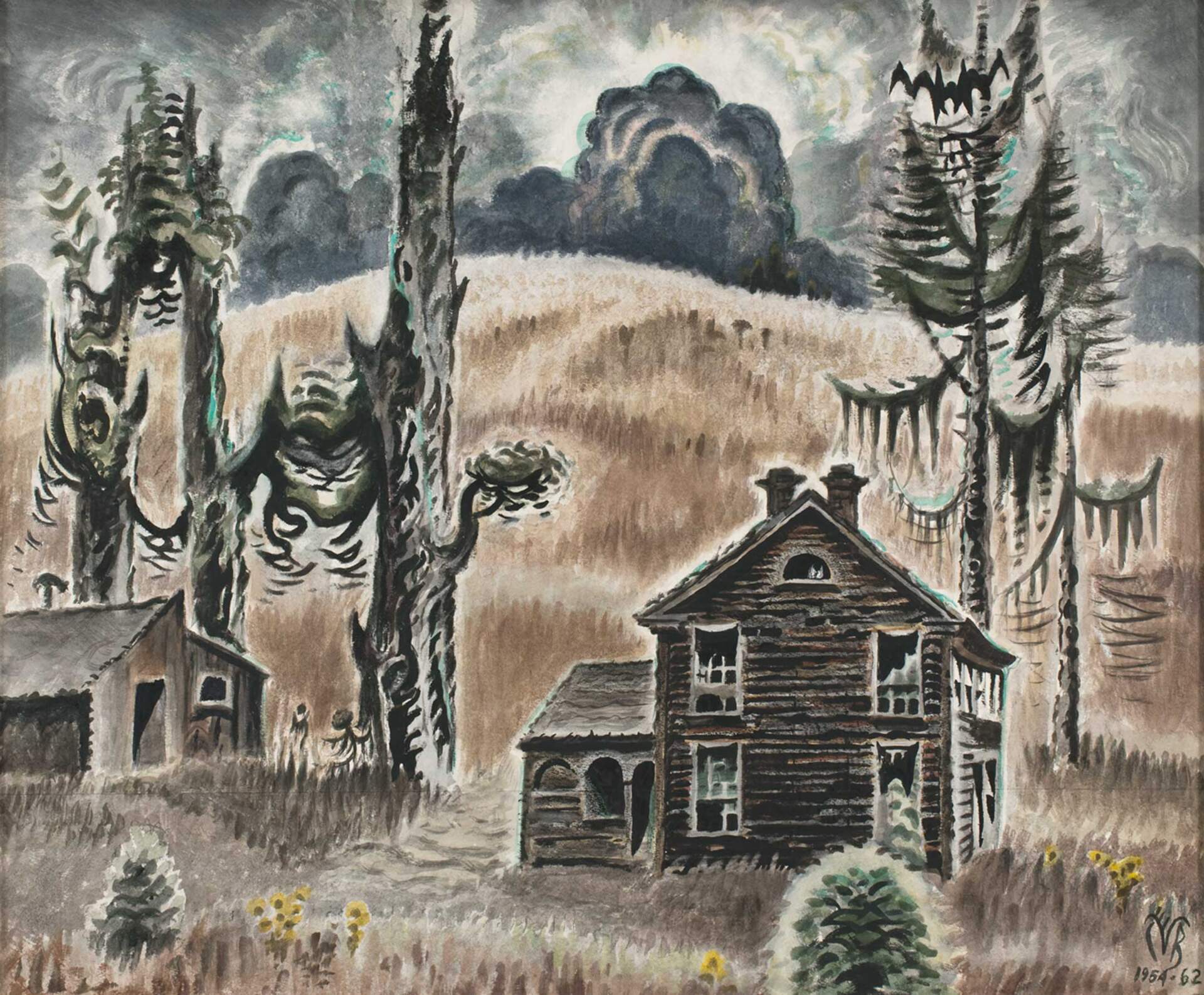
Charles E. Burchfield (1893-1967), The Haunted Twilight, 1954-62; watercolor and charcoal on paper, 32 3/8 x 39 1/8 inches; Burchfield Penney Art Center, Gift of Charles Rand Penney, 1994
Something Sinister: Tullis Johnson on Charles E. Burchfield’s Haunted Landscapes (Podcast) with Daniel Lendzian of Buffalo Rising
Monday, Nov 2, 2026
This fall, the Burchfield Penney Art Center prepares for scares as Something Sinister: The Haunted Landscapes of Charles E. Burchfield opens October 29, 2026, and runs through February 28, 2027.
Tullis Johnson, Charles Cary Rumsey Curator at the Burchfield Penney Art Center, who curated Something Sinister, sees the exhibition as part of the museum’s larger mission to connect Burchfield’s work with the Western New York community and its artistic identity. He explained:
When we opened our new building in 2008, our slogan was, ‘We are your Burchfield Penney Art Center,’ because we are the Museum for Western New York Art. We focus on the art of the people around us in our community… we’re here to cultivate and elevate the work of Charles E. Burchfield, the great American artist, and Western New York artists. But we go a little bit beyond that now with a vision statement and some core values, and I really think those are worth sharing as well. We want to create a community where people are inspired to explore, enjoy, and create art. And our core values are to be gracious, inclusive, and local. And they’re all important. But local is the one that really speaks to me because local can work on a lot of different levels. It can mean your community right around you where you live. It can mean the city of Buffalo that, you know, there’s so much pride here in Buffalo, but it’s really all of Western New York. It’s all of the 716. We’re here to celebrate that.”
The exhibition’s title came from a journal entry by the museum’s namesake. The phrase appeared in 1919, which Johnson called “a very strange year in this country,” noting that it was the year after the First World War and that Burchfield had just returned from his Army service. He had served in the Army’s camouflage unit, where he was responsible for camouflage work, including painting guns. All the while, the 1918 influenza pandemic was occurring in the background, providing the context for Burchfield’s journal entry.
Johnson then shared the journal entry behind the title, a passage that reads almost like a miniature horror story:
He had been out walking and had committed some thoughtless transgression against the laws of the woodlands. Perhaps it was that he had unwittingly failed to look at the first wildflower or had neglected a bird song. At any rate, he went over the soggy brown hills in the purple dusk. He had that ominous feeling of something sinister following him. He came running in, breathless and terrified.
Johnson started to “think about just how strange and sort of sinister some of [Burchfield’s] works are. How buildings, how the built environment comes to life, how he painted the sounds of the crickets and of the kinds of things that he saw in nature. And I thought, ‘this is something I can really build an interesting exhibition around.’”
The exhibition features many works whose titles use the word haunted. “The title piece for the exhibition is called The Haunted Twilight… It’s a painting of a house in Teegarden, Ohio, that he probably saw even before he went to college, but that he painted over and over again… Another really great piece is called February Dusk. And it is in that piece, it’s the lights in the windows. You wonder what’s really going on behind those windows.”
Johnson describes the exhibition as an exploration of Burchfield’s early interest in an “emotional topography,” where the natural world reflects feelings of dread, anticipation, and wonder. “Whether it’s through the crows flying through the forest, or the light in the window of that ramshackle house that is long gone,” Johnson feels the exhibition demonstrates Burchfield’s fascination with the ways the landscape can take on an emotional life. “I wanted this idea of something sinister, the haunted landscapes. I wanted it to be accessible. I wanted it to be something a lot of people could connect with and say, ‘Ooh, what’s that about?’ And it is no mistake that the exhibition opens just a few days before the end of October.”
Whether Buffalonians see the exhibition at the end of Spooky Season, or if they wait to feel the resonance of Burchfield’s work in the bleak midwinter, Johnson hopes “that it inspires people to see the life in nature and in the built environment around them in the way that aging buildings can come to life…in the way that lights in the windows of a building can anthropomorphize… and make it feel like it has a face and like it has an expression. And that’s really what I try to do with a lot of my Burchfield exhibitions: to show our visitors what he’s shown me and what he continues to show us about the American landscape and about everything that surrounds us.”
Something Sinister: The Haunted Landscapes of Charles E. Burchfield opens October 29, 2026, and runs through February 28, 2027.
To hear the entire interview visit Buffalo Rising.