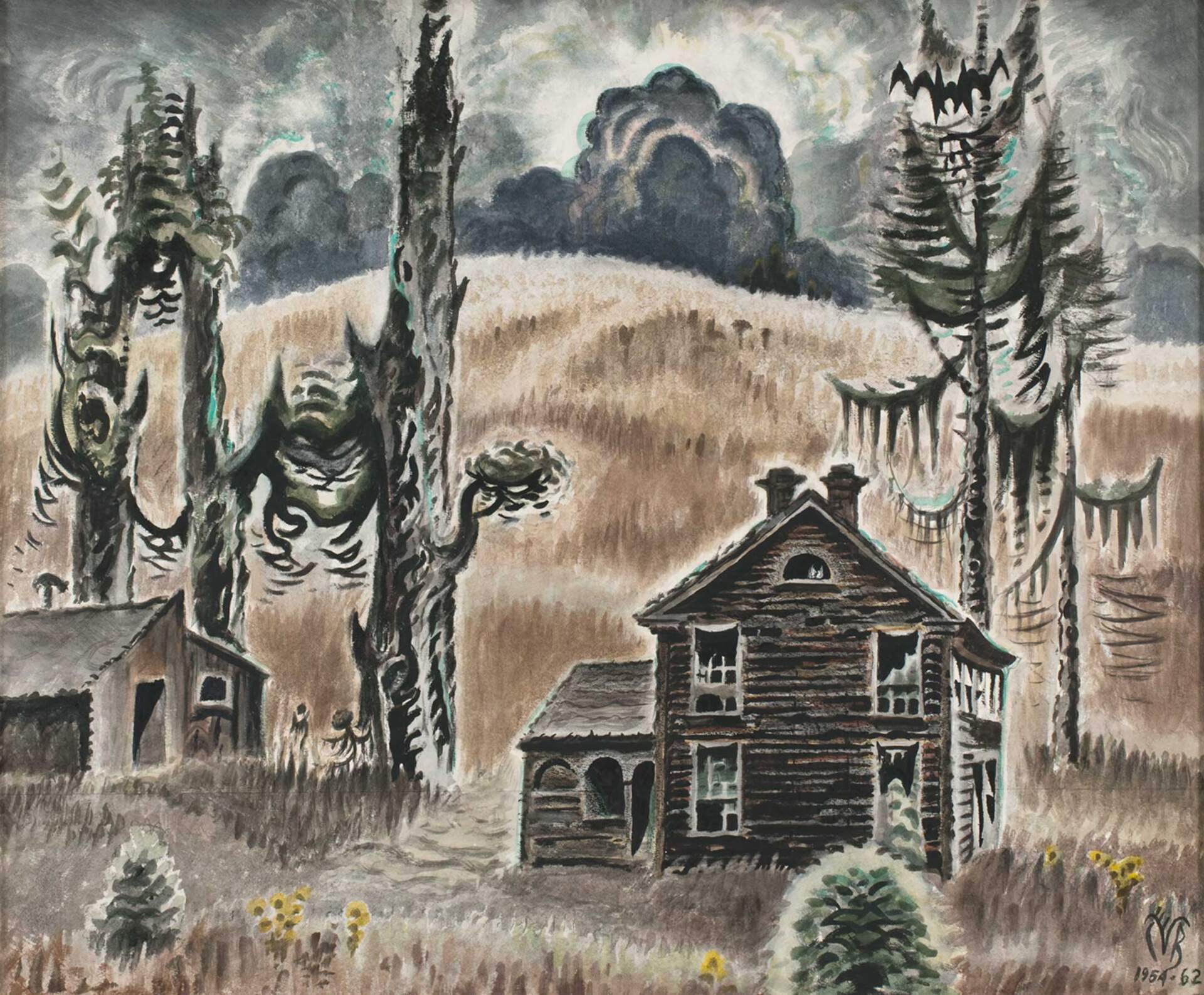
Charles E. Burchfield (1893-1967), The Haunted Twilight, 1954-62; watercolor and charcoal on paper, 32 3/8 x 39 1/8 inches; Burchfield Penney Art Center, Gift of Charles Rand Penney, 1994
Something Sinister: The Haunted Landscapes of Charles E. Burchfield
Upcoming
Oct 29, 2026 — Feb 28, 2027
Something Sinister brings together a concentrated selection of works by Charles E. Burchfield that reveal the artist not simply as a painter of nature, but as one of the most psychologically acute and unsettling visionaries in American art. Across these paintings and drawings, familiar places; houses, streets, interiors, and landscapes become charged with unease, as if animated by unseen forces or haunted by memory itself.
The title Something Sinister comes from an entry in Burchfield’s journals from February 14, 1919. In it he wrote:
He had been out walking and had committed some thoughtless transgression against the laws of the woodlands. Perhaps it was that he had unwittingly failed to look at the first wild flower, or had neglected a bird song. At any rate, as he went over the soggy brown hills in the purple dusk, he had that ominous feeling of something sinister following him… He came running in, breathless and terrified. They all crowded around curiously to discover the cause of his fear.
He turned and glanced behind him wild eyed. They looked too and saw with horror that the lean gray woods, with two black cavities in front had followed him home. They shut the door hastily and the woods howled and beat with its branches against the doors and windows.
After he had gotten into bed and the covers had caressed him into a half slumber, something by the horror of its presence, attracted his eye to the door of his room. — It had somehow gotten into the house. The other night when the woods came into the room it seemed angry – But tonight when it came in it took no notice of him but glided gracefully about the room, chanting at times. Its voice was like the memory of a peter bird’s song, and had something of the strangeness of the north in it.
The term sinister is often associated with danger, menace, or evil, but in Burchfield’s work it carries a more nuanced meaning. Derived from the Latin sinistra, meaning “left,” the word has a curious resonance for Burchfield, who was himself left-handed. Here, the sinister describes the uncanny feeling that ordinary places are charged with unseen energies and hidden significance. It is less a source of terror than a condition of heightened awareness, where fear and wonder coexist, and where the boundaries between memory, imagination, and the natural world begin to dissolve.
Drawn from works such as Night Landscape (1917-18), Deserted Miner’s Home (1918), and Memory of a Dream (1919), the exhibition foregrounds Burchfield’s early explorations of what might be called an “emotional topography,” in which the external world mirrors inner states of dread, anticipation, and wonder. In these works, architecture leans, windows stare blankly or glow ominously, and the natural world seems to listen as much as it reveals. The recurring motif of the lit window—seen in works like Haunted Evening in Spring (1947) suggests both refuge and exposure, a fragile boundary between interior consciousness and the vast, unknowable outside.
At the center of the exhibition is The Haunted Twilight (1954–62), a late masterpiece that revisits and amplifies the psychological intensity of Burchfield’s early years. Here, the landscape itself appears sentient, its forms trembling with energy, its atmosphere thick with presence. Nearby, works such as Bird Wing, Twilight (ca. 1951) extend this sensibility into a language of abstraction and symbol, where sound, movement, and emotion are translated into visual equivalents.
Equally important are the more enigmatic and narrative works, including Tree and Pool and Passing Train (Flooded Field) (1920) and Robin Song at Dusk (1918), where fleeting moments are imbued with an almost supernatural significance. In these images, the ordinary becomes uncanny—not through dramatic gesture, but through a subtle distortion of perception, a sense that something just beyond comprehension is unfolding.
The exhibition also includes a group of rarely seen works from the Charles E. Burchfield Foundation Archives, alongside loans courtesy of The Charles E. Burchfield Foundation and DC Moore Gallery, situating these haunting visions within the broader arc of the artist’s career.
Together, these works suggest that Burchfield’s true subject was never landscape alone, but the experience of being in the world—alone, alert, and susceptible to its mysteries. His paintings do not depict the sinister so much as generate it, inviting viewers into a space where perception falters, and imagination takes hold.
Tullis Johnson, Charles Cary Rumsey Curator