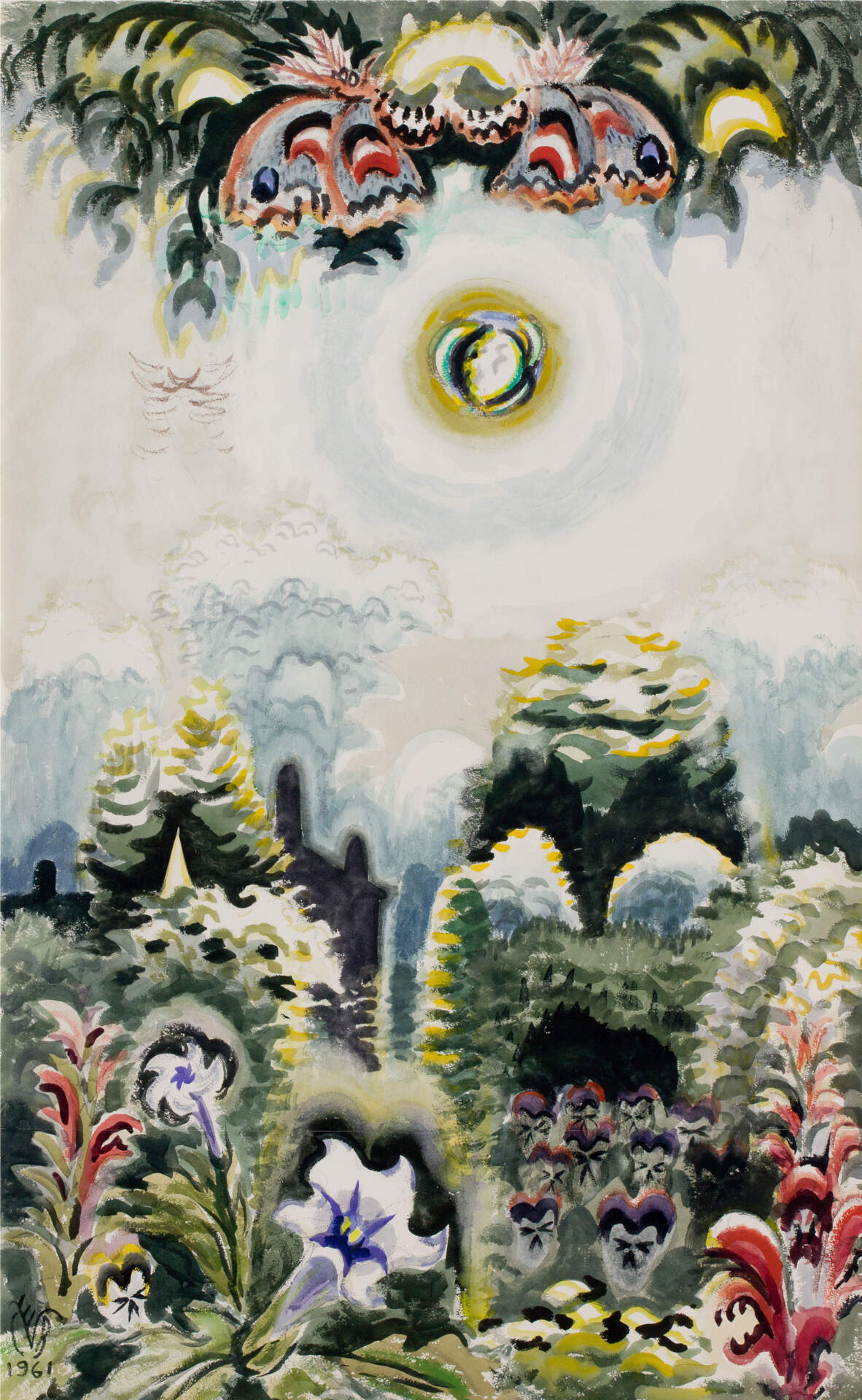
Charles Ephraim Burchfield (1893-1967), Moonlight in a Flower Garden, 1961, watercolor and charcoal on joined paper, 48 x 30 in. (121.9 x 76.2 cm.), Young Sloan Collection
A VAST, tiny WORLD
Burchfield's Insects & Spiders
Upcoming
May 8, 2026 - Aug 30, 2026
Did you ever imagine, with childhood wonder, being so tiny you could live among flowers as tall as trees and converse with critters, once nearly invisible, now the size of companions? Alice’s Adventures in Wonderland, one of Charles Burchfield’s favorite books, portrays an anthropomorphic fantasy that materializes, in essence, in many of his paintings and drawings. Plants and trees seem to have human emotions and traits. Floral aromas perfume the air so pungently that he even believed trees could smell their scent. Insects and spiders that live often hidden in the landscape are exaggerated in scale to give them agency. Their flight and sound patterns become visible, their animated energy captured in two-dimensional images.
In Burchfield’s art, oversized cicadas rattle metallically, hidden crickets fiddle in the grass, katydids creak their names, and humming mosquitoes sting maddeningly. Twelve-spot skimmers dart over a stream strewn with pond lilies. Colorful Monarch and Swallowtail Butterflies flutter in airy arabesques and inhabit dreams. Sporting wings emblazoned with crescent moons, Cecropia Moths provide an air of mystery to summer nights. “The most beautiful things of the evening are the fireflies,” Burchfield declares. In the arachnid world, a golden-orb spider weaves glistening webs that capture “drops of sunlight” that glide on the gossamer. These windows on a microcosmic world guide us to appreciate a world for which many of us are blind. But the more we learn, the more exciting it becomes.
Artworks in this exhibition, curated by Burchfield Scholar Nancy Weekly, are drawn from the Burchfield Penney Art Center’s substantial art collection and archives, and lent from private collections. They offer a glimpse into the artist’s inclusion of some of the smallest creatures that are part of the immense ecosystem we inhabit. Through his inventive means of expressing his own sensations while scrutinizing, listening, and smelling inspirational landscape scenes, we come to appreciate the fullness of shared experiences. Burchfield is our nature guide.
In addition, a few works by Western New York artists provide different views of similar subjects. Specimens and soundtracks of distinctive "insect songs" add to the verisimilitude and learning opportunities. The Education Department plans to offer a workshop on drawing "doodle-bugs" based on Burchfield's doodles created by mirroring names written in script. An exhibition brochure will document this unusual subject.
A VAST, tiny WORLD: Burchfield’s Insects and Spiders is presented through the generosity of the Charles E. Burchfield Foundation. For their meaningful support in memory of Harriet and Mortimer Spiller, we gratefully acknowledge Lora Spiller, Jill Spiller Underwood, and Harley Spiller. Our heartfelt appreciation, also, to Mrs. John Kociela, for her generous support.