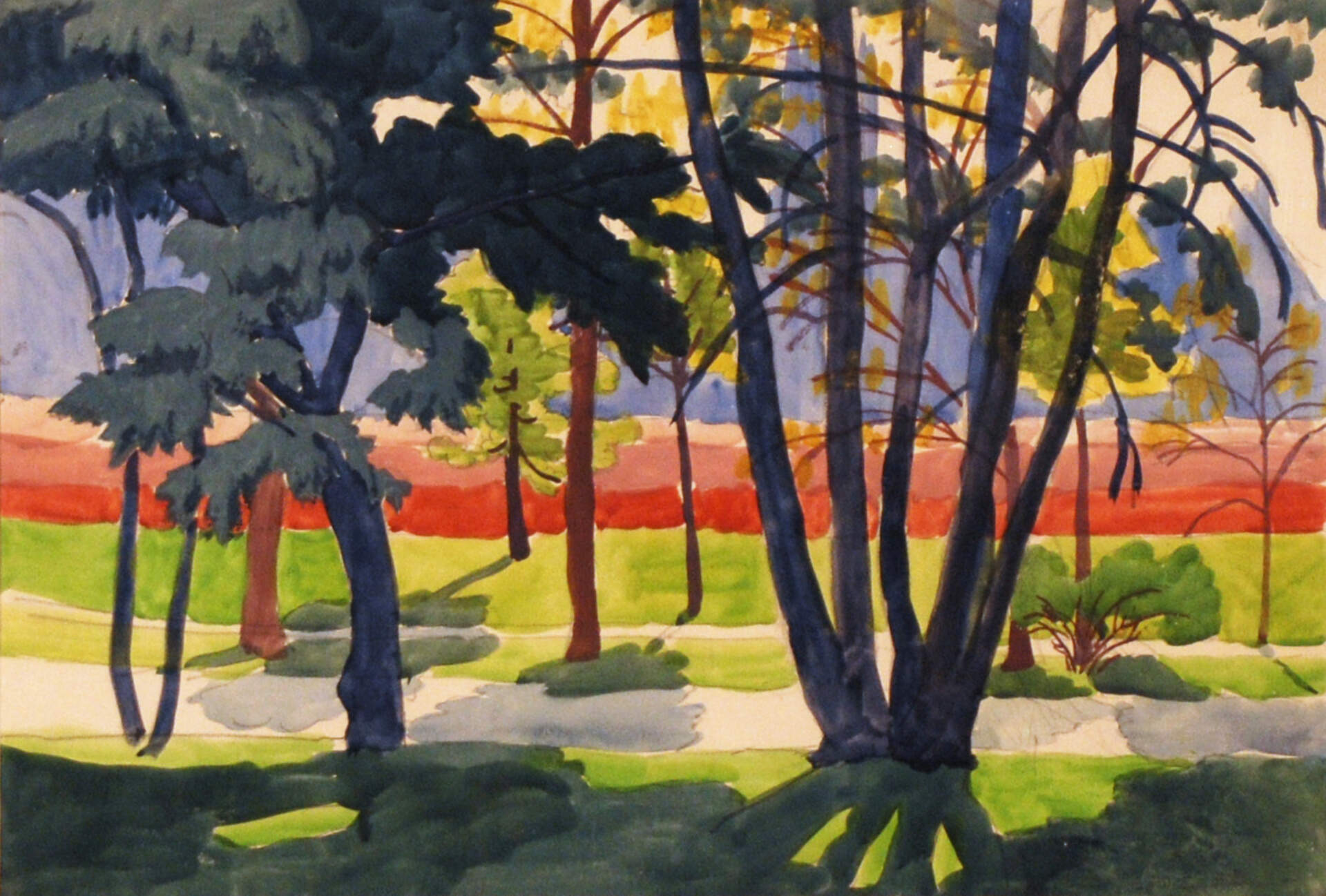
Charles E. Burchfield (1893-1967), Untitled (Clump of Purple Trees), October 1915; watercolor and graphite on paper, 13 1/2 x 19 1/2 inches; Burchfield Penney Art Center, Gift of Tony Sisti, 1979
Charles Burchfield: Nature as Muse
Past
Apr 27, 1986 - Jul 13, 1986
When a subject stimulates an artist over his entire lifetime, it must be both profound and elusive to hold him in thrall. Such is the case for watercolorist Charles Burchfield with Nature. Nature was a source of inspiration since he was a young man toying both with the idea of studying flora and fauna scientifically as a naturalist and capturing his emotional reactions to his environment in the form of drawings and paintings. Childhood fears and wonder charged his early work with an energy that he returned to later in his life. Burchfield has often been called "The Last American Pantheist" because of his deep commitment to Nature as primary to his personal spirituality. Thirteen works from the permanent collection and two works on extended loan to the Center dating from 1916 to 1964 comprise this exhibition of paintings that, through the use of color and composition, reveal a measure of Burchfield's awe for Nature. No subject was too trivial, be it spider or wildflower. Take, for example, "May Wind and Hay," 1964, a magnified detail of a country field in motion. Through Burchfield's transformation of seemingly inconsequential material to a status of prominence and distinction, the viewer is able to share the artist's view and appreciate life with a renewed enthusiasm. In "New Live," which was begun in 1919, destroyed, and recreated in 1963, Burchfield tries vicariously to perceive the world from an imagined perspective of a bird and it is through this repositioning that one can share his curiosity. He focuses on the birth of a bird as a symbol of cyclical change, thereby shifting from documentation to ideological discourse. --Nancy Weekly, Charles Cary Rumsey Curator, 1986