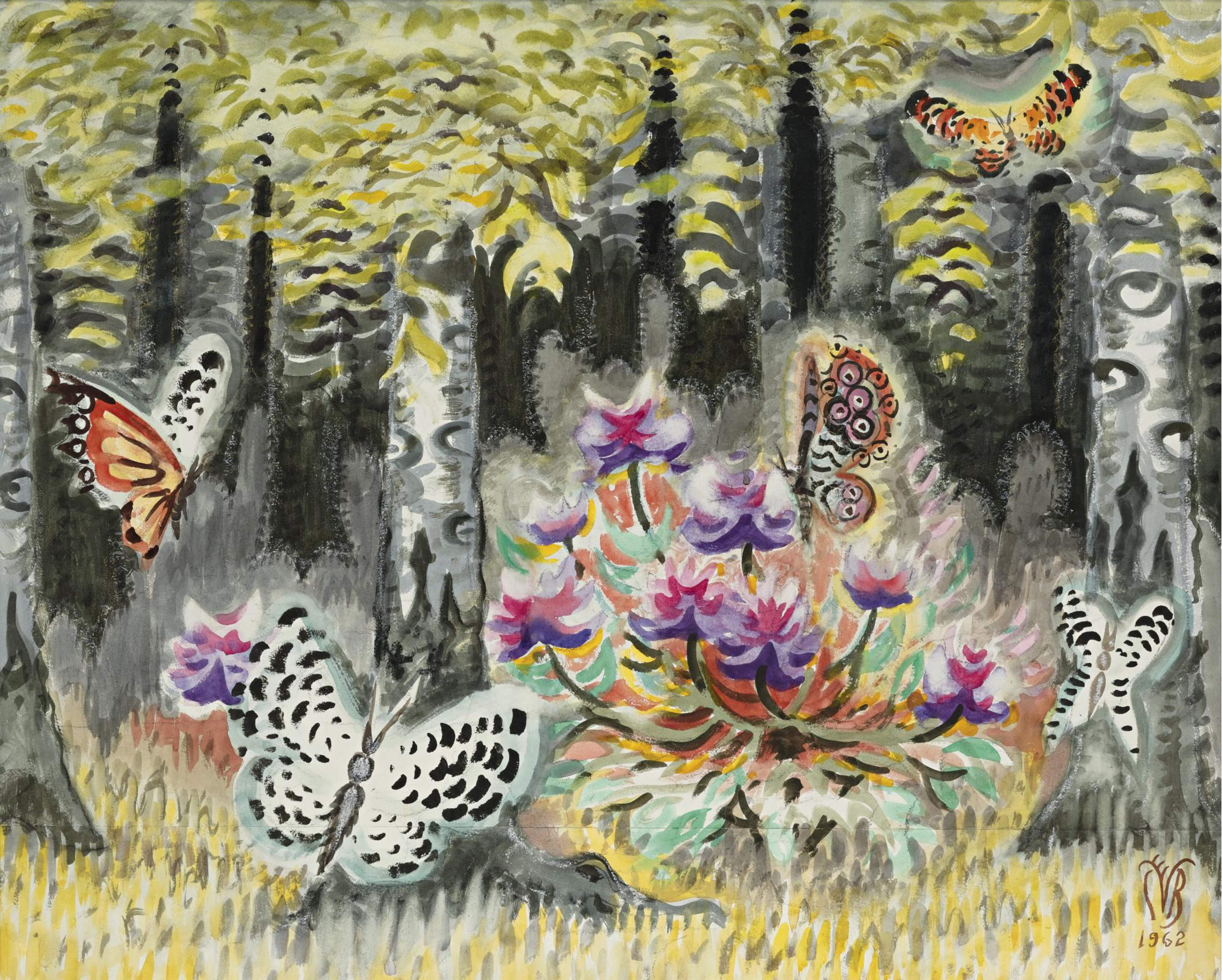
Charles E. Burchfield (1893-1967)A Dream of Butterflies
1962
watercolor on paper
33 x 40 inches
Image from the Burchfield Penney Archives
Excerpt from: "MODERNISM, BEAUTY, UGLINESS, AND MAGIC" in the exhibition catalog for A Grammar of Animacy: Charles E. Burchfield and Mike Glier, November 8, 2024-March 2, 2025. Artist Mike Glier and Burchfield Scholar Nancy Weekly discuss A Dream of Butterflies (1962) shown with his two works, The Evensong of Animals (2023) and When the Last Monarch Leaves New York This Painting Will Shake and Moan (2023).
MG: I am very excited to have A Dream of Butterflies in the exhibition!
NW: Me too! I have never seen A Dream of Butterflies in person. Dream imagery like this is so vivid and joyful, the brain’s way of manifesting and intensifying actual experiences. Charles and Bertha Burchfield’s serendipitous trip to the countryside on June 22, 1962, reflects a plausibly influential event. They packed a picnic lunch and ventured to a quiet spot. He sets the stage by noting: “We enjoyed watching the various insects busy here— orange-tan and brown skippers, 4 or 5 of them; tiny young grasshoppers; a miniature tree-frog, and beautiful small dragon-flies with invisible wings, rich cerulean at the head graduating to metallic emerald blue green at the tail, the brilliant color cut by narrow segments of dark gray — these were a delight to watch.” Not only was this visually idyllic, but lilting sounds also enriched their experience. “From the depths of the woods close by a wood-thrush sang intermittently. Once a “blue” (butterfly) fluttered in erratic flight past us.” This resonated in his unconscious mind because he dreamt of “Albino” Monarchs–an image so powerful he was compelled to paint it.
MG: This painting is modern and so beautiful. On the first count it’s clear that Burchfield’s design sensibilities are modernist in that he limits volumetric forms in favor of flat shapes and creates the illusion of depth by overlapping forms and softening edges and contrasts as he develops deep space. Linear perspective is left at the door and replaced with dramatic changes of scale to suggest spatial relationships. But like all good modernists of the twentieth century, he plays with these variables in unexpected ways, like making the butterflies and the flowering plant enormous in relation to the trees!
NW: Burchfield was first identified as a modernist in April 1930, when Director Alfred H. Barr, Jr. gave him the first solo exhibition at the Museum of Modern Art. Established November 7, 1929, MoMA was “the first institution anywhere in the United States to devote itself exclusively to Modern art.” The exhibition focused on his early watercolors from 1916-1918. Barr admired how Burchfield’s “romantic qualities or vices” were overshadowed by strong design, conviction, and youthful inventiveness.
MG: Ha, “Vices”! High Modernist critical language was bracing!
NW: A Dream of Butterflies demonstrates how that aesthetic continued. He resists being a realist because there is so much more to the experience that mediates the senses and enters a more symbolic realm. In this work, he sets up a pattern of black woodland depths dancing across a stand of beech trunks. Cascading golden leaves move rhythmically in counterpoint to the butterflies. Looking closer, note how the eye patterns and radiating crescents on butterfly wings mimic tree eyes, and leaf edges, and the linear articulation of flowers and stems that float into the air. Even the grass quivers.