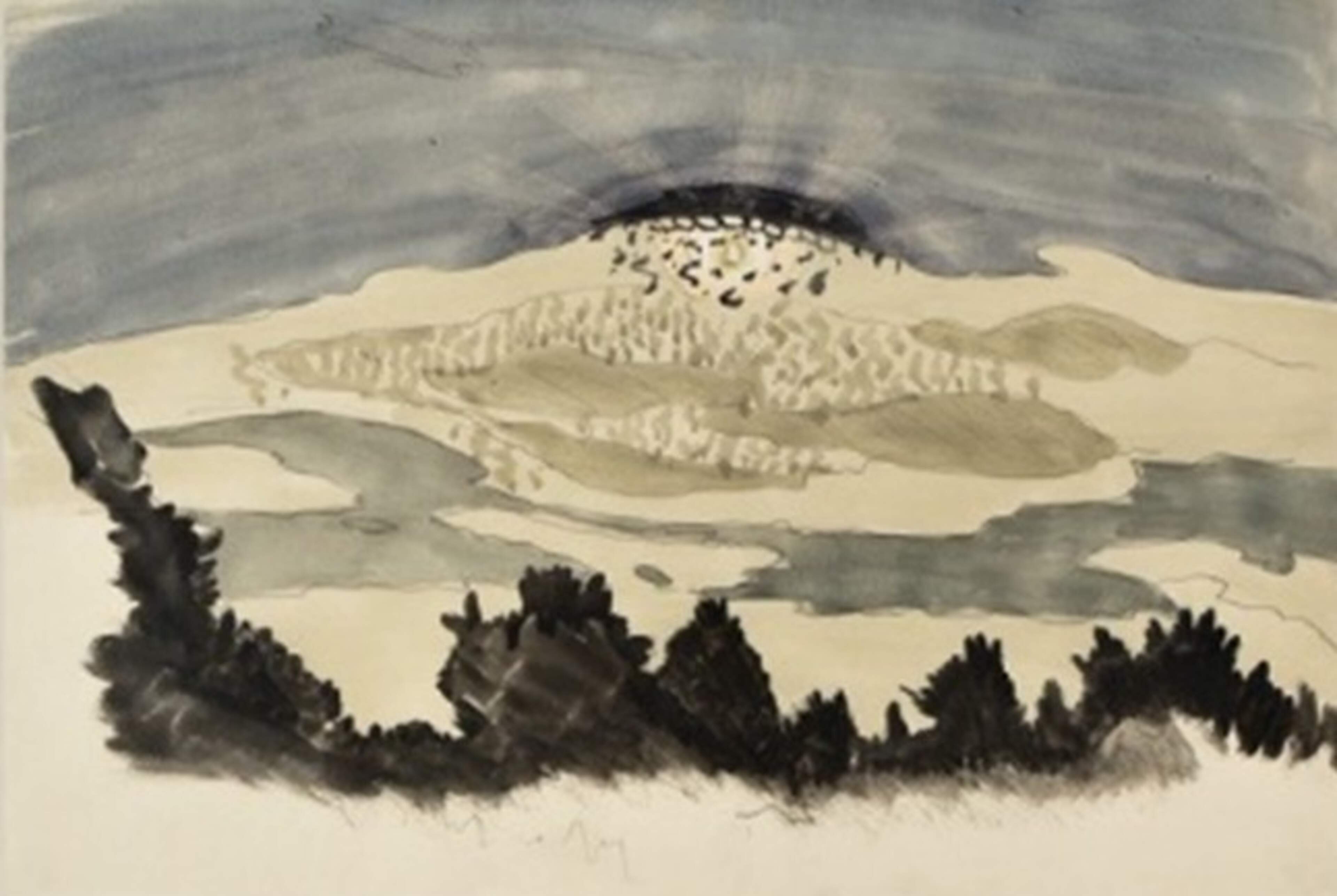
Charles E. Burchfield (1893-1967)Untitled (“Billions of tiny flies”)
September 6, 1916
watercolor and pencil on paper
14 x 20 inches (35.6 x 50.8 cm)
Private Collection
Burchfield's journal entry for September 6, 1916 reveals the subject of this painting:
A big dreamy day – It is summer again – Great patches of dapples move stagnantly from the north – The noon sunlight is brilliant
In the horizon mellow sunlight billions of tiny flies streamed westward looking like snow against the shadows of things – whence came they, where are they going?
It is a wonderful event –
The moon at top of romantic patch of clouds which looks like the insides of a milkweed pod –
Black sunflowers against the moon –
The insects depicted are: Green Midges (Tanytarsus spp.) 1/4–3/8” (5-10 mm) Wings milky, transparent. Habitat: Meadows and woods, near wetlands. Food: Wet organic matter, mostly in silt at bottom of quiet ponds, streams, or marshes. Males perform aerial dances in large swarms, often above a shrub or treetop, usually in the evening. Females enter swarm and are seized by males. Pairs drop below swarm to mate. Mated females thrust eggs through water surface film. Larvae wriggle through bottom silt to reach decomposing plant matter. At end of pupal stage, pupae float to surface and explode suddenly to release adults. Midges do not bite but are often mistaken for mosquitoes, particularly when swarming. On cooler days they usually swarm in the late afternoon when they are warmed by the sun.
— Nancy Weekly, Burchfield Scholar, 2026