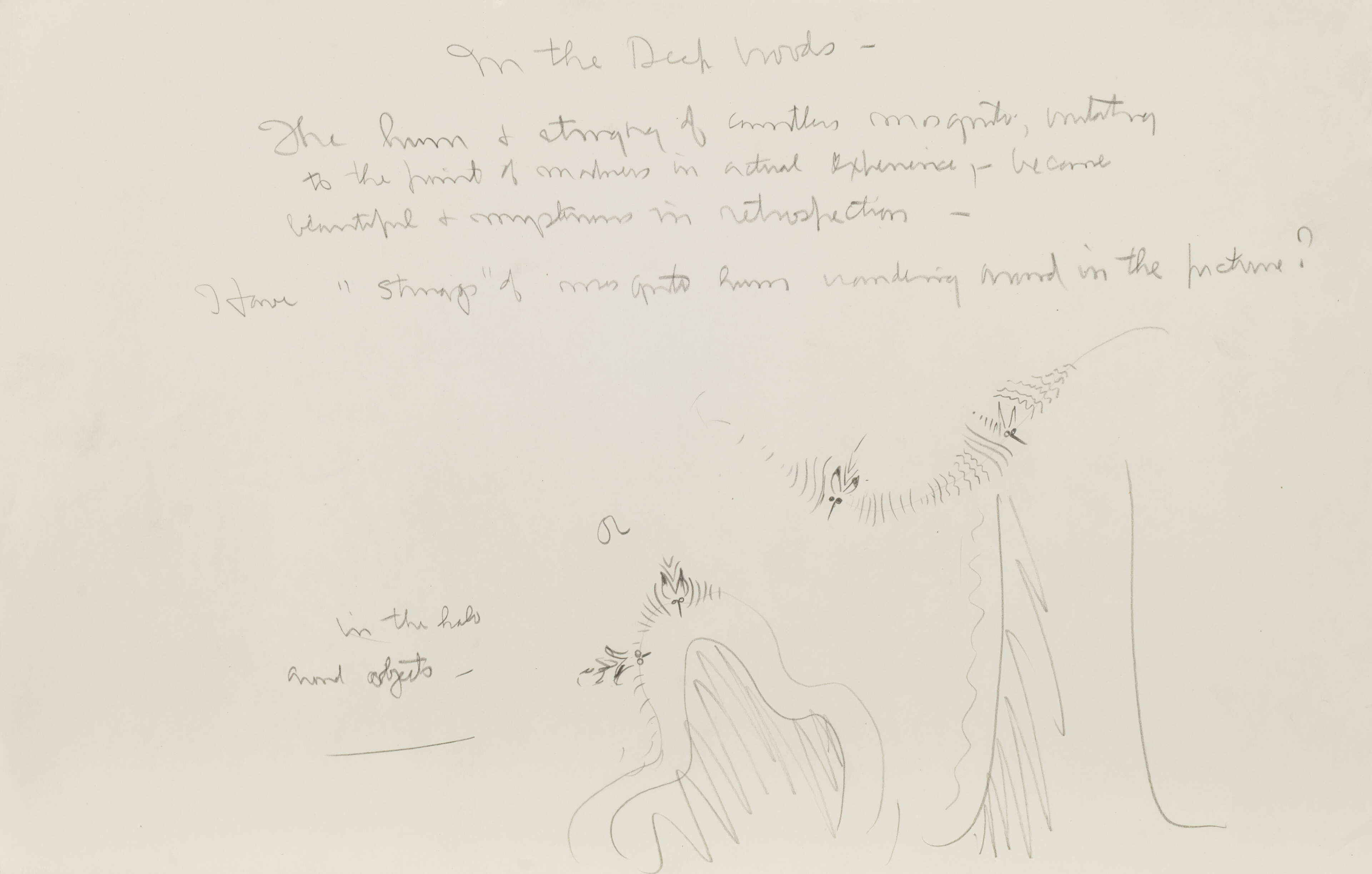
Charles E. Burchfield (1893-1967)Study for In the Deep Woods
c. 1956
Conté crayon on paper
11 1/8 x 17 inches
Burchfield Penney Art Center, Charles E. Burchfield Foundation Archives Gift of the Charles E. Burchfield Foundation, 2006
Titled “In the Deep Woods” with notations: The hum & stinging of countless mosquitoes; imitating to the point of madness in the actual experience, - become beautiful & mysterious in retrospection – / Have “strings of mosquitoes hum wandering around in the picture? – or – in the halo around objects”
Mosquitoes (Family Culicidae)
Mosquitoes are slender, delicate flies, usually less than 1/4" (6 mm) long, with slender legs. They are easily recognized by the long, sharp proboscis, which immediately distinguishes mosquitoes from midges, fungus gnats, and other similar insects. The male has very feathery antennae unlike the female’s sparsely hairy antennae. The wings of both sexes are coated with delicate scales. At rest the wings are neatly folded over the abdomen. These common insects are best known for the biting habits of females, which must have a blood meal before they can produce eggs. Males do not bite and generally feed on plant juices. Mosquito larvae, called wrigglers, grow to 3/4" (18mm) long and the pupae to 1/4" (6 MM). They live in quiet bodies of water, ranging from fluid-filled leaves of pitcher plants to stagnant ponds and lakes. Of all insects, mosquitoes are probably the most harmful to people, because they help transmit such serious epidemic diseases as malaria and yellow fever.