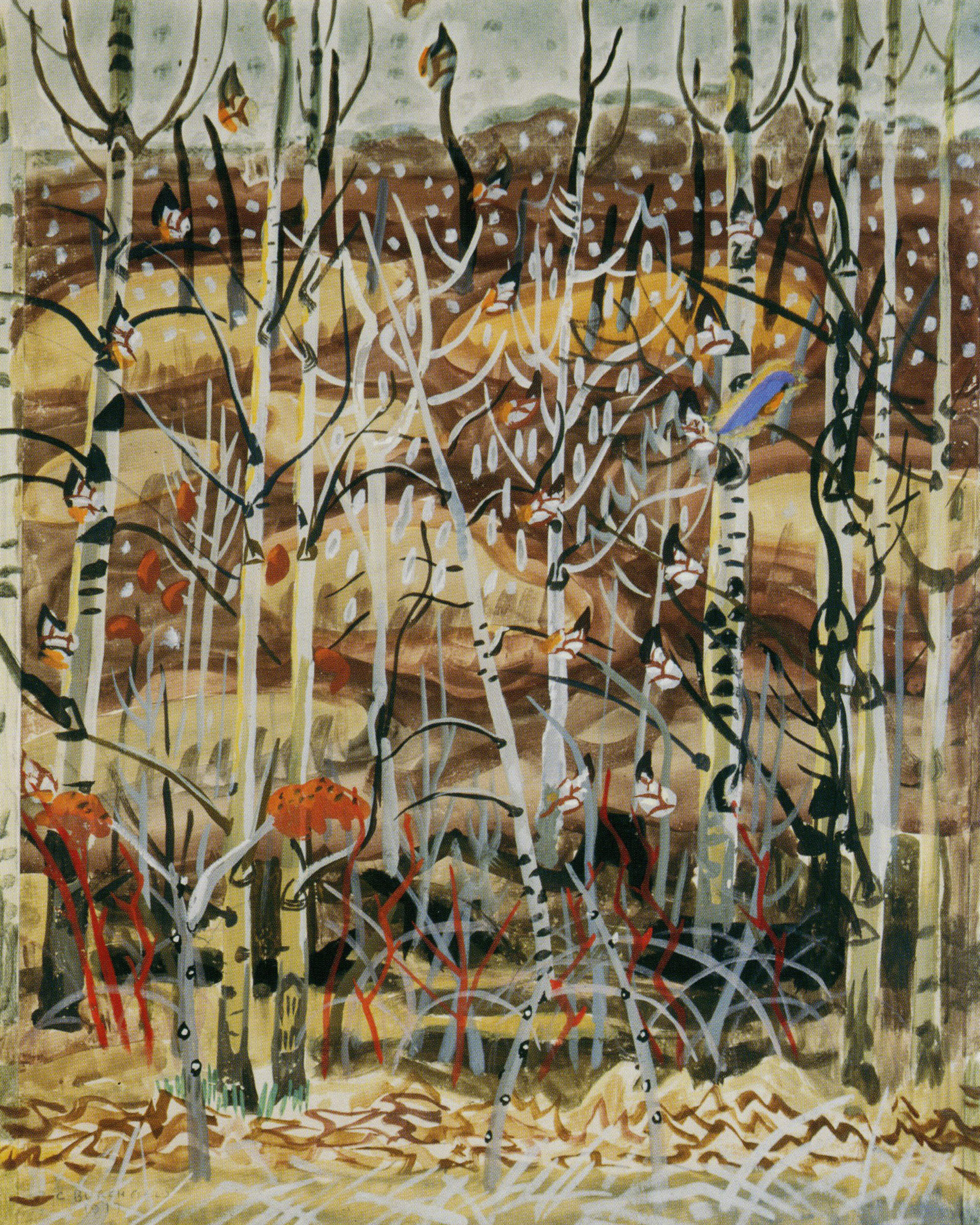
Charles E. Burchfield (1893-1967)Bluebird and Cottonwoods
1917
watercolor, gouache and graphite on joined paper mounted on board
23 5/8 x 19 1/2 inches
The Malof Family
Bluebird and Cottonwoods, painted by Burchfield in 1917, conveys a scene dominated by linear elements that seem to come to life through these designed patterns.--Content developed by Tullis Johnson, Brian Grunert and Kyle Morrisey for the exhibition Charles E. Burchfield: By Design
Bluebirds have a vibrant azure color on their upper body and wings, red breast, white belly, and warbling song, making them welcome symbols of spring when they return north. These may be reasons why Burchfield considered them a symbol of hopefulness. They even appeared in his dreams, as he noted on March 27, 1917, writing: “I was dreaming I had been forsaken by all my beloved and sat by a stream in the woods in misery, when a bluebird fluttered up strangely tame & sat on my knee —” This painting became the inspiration for Burchfield's first wallpaper design, The Birches, in 1921.
--Content developed by Nancy Weekly for the exhibition A Dream World of Imagination: Charles E. Burchfield's Golden Year
Excerpt from the essay, “The Open Road” by Nancy Weekly (2001):
Bluebird and Cottonwoods (1917, pl. 14) captures the springtime in Salem. Young cottonwoods bearing catkins are nestled in front of a rocky hill, providing safe haven for a brilliantly plumaged bluebird. The shy bird stands out startlingly from the camouflaged background. Within four years, Burchfield returned to this image for a commercial design application. In 1921 he moved to Buffalo, New York to become an assistant designer for the M. H. Birge & Sons Company, under the supervision of Edward B. Sides, the head designer. Before the year was up Burchfield was asked to design some wallpapers himself, so he quickly converted subjects from earlier, decorative paintings. Bluebird and Cottonwoods thus transformed into his wallpaper design for The Birches (pl. 15). Years later, on a sample of The Birches wallpaper that was subsequently donated to the Burchfield-Penney Art Center, Burchfield had written that this was “The first design I made for the Birge Co. (and just about my favorite).”19 The wallpaper design was offered in numerous color variations, including silvery grays and blues.