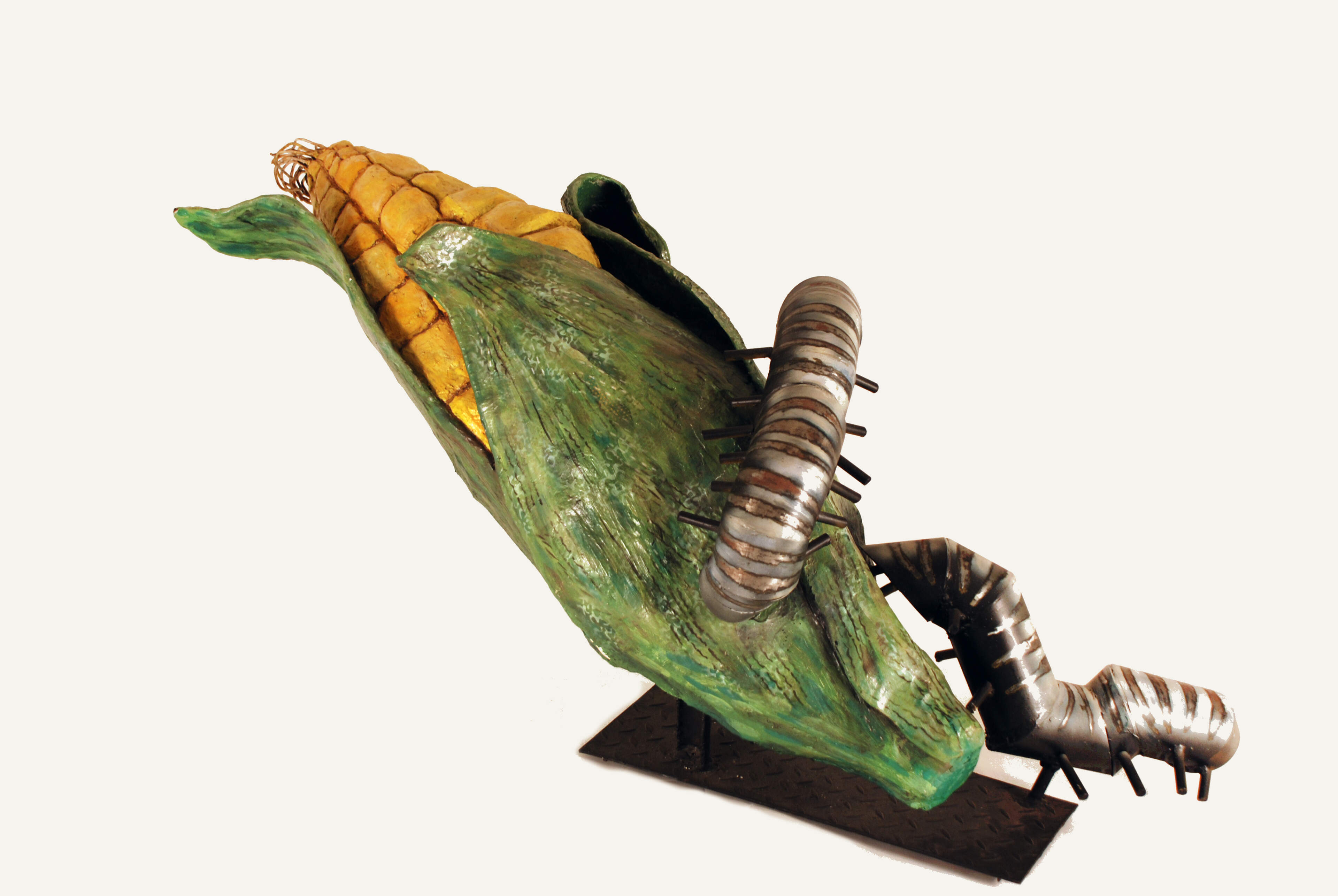
Christy Rupp (b. 1949)Home Town Hunger
1986
steel, plaster, and paint
33 x 64 x 24 inches
Burchfield Penney Art Center, Gift of the Artist, 1992
Excerpt from "Christy Rupp: Natural History Meets Coney Island and the Sandinistas" by Lucy R. Lippard in the exhibition catalog, Natural Selection: Sculpture by Christy Rupp (Buffalo: Burchfield Art Center, 1990):
For several years, most of the polychromed steel pieces were small, and confined to galleries. But they raised increasingly large questions about the economic relations of the Third to the First World. In her 1986 exhibition at PPOW Gallery in New York. Rupp continued to attack pesticides, industrial pollution, unemployment, and corporate irresponsibility. This time she used a paradoxically small scale to tackle these giant issues. The small metal pieces suggest frames from an animated film about hemispheric economics. Titles like Pestilence and Plague, Skilled Labor from Somewhere Else, Hometown Hunger, and The Workerless Recovery (about the Reagan miracle in which "everybody could get jobs" at Burger King for a minimum wage) led Roberta Smith to call them "three-dimensional political cartoons" in the New York Times. This is not really an insult, but Rupp's punning visual/verbal wit does evade the obvious.
Each of her sculptures has more dimensions than immediately meet the eye. And particularly important, in an artworld that shies away from topicality, they come to grips with major social problems rarely seen in art contexts. Uprooted Plant, about runaway industry, is a factory building ripped up by its roots by a huge shovel—a painfully graphic image of de-industrialization in the rust belt. Turtle Trying to Get into Its Shell is a metaphor for "attempting to fit into an alienating culture that doesn't work for you." Trickle Down is a formally delightful illustration of Reaganomics with grasses, fish and supporting rod integrated into a delicate tower. The fish at the top nibbling from the algae gets the good meal, while the one on the bottom gets only an old beer can. An equally airy, zany, and tragic structure is the catchily titled Runaway Factories Become a Bobsled—Rust Belt, which has the graceful intricacy of a Nancy Graves, plus content. (The belt moves and the factories turn into a bobsled with no brakes.) In Unsolid States—Sub Machine Culture which could be about the Third World or about Flint, Michigan, the guy luckily enough to get a job is impaled on the machine while a little sports car leaves the scene of the crime like a local dictator or corporate oligarch.
Other pieces in this series are more like one-liners. "Convalescing Staple Crops and Recreational Export Crops" is a series, including an ear of corn in a wheelchair while sugar can zooms by in a convertible, and golden tobacco leaves luxuriating in a red plushy armchair before a fire, as well as Rice in Traction, Cotton on Skis, and Coffee and Tea Play Ball. Inextricable from these themes us the Latin American debt, which Rupp treated in the context of a show on the Debt at Exit Art in 1988. Her Harvest of Lost Shirts, made just after the stock market crisis of October 19, is a lawnmower moving across the grassy dollar bill, the idea being that like a lawn, money is totally unnatural and human-made. "We should just forgive the debt because the dollar losses are just paper losses, they don't represent anything more important than mowing your lawn on a Saturday morning, as this country sees it."