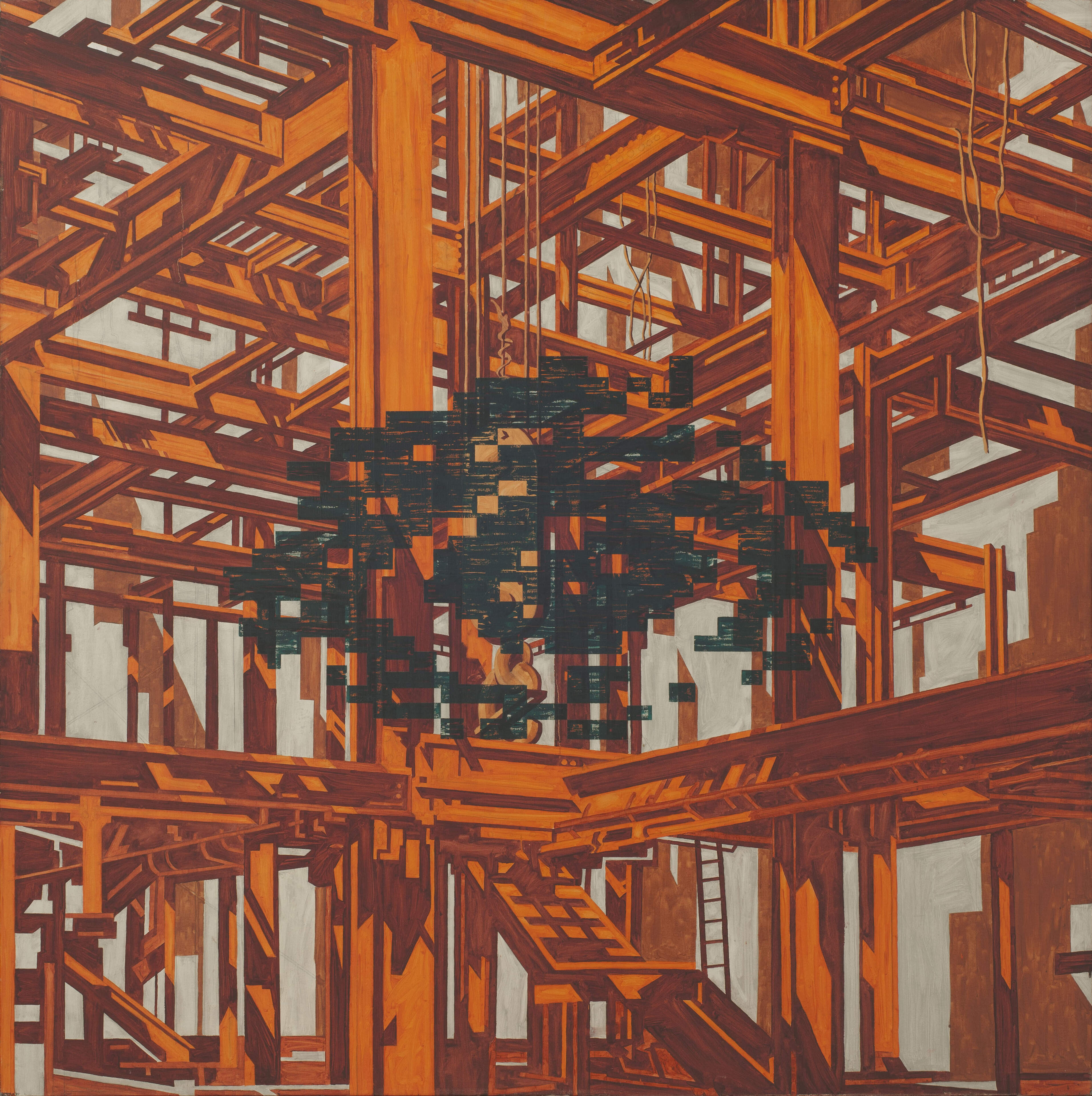
Steve Miller (b. 1951)Panopticon
1983
Oil on canvas
72 x 72 inches
Burchfield Penney Art Center, Gift of the Artist, 1991
A panopticon is “a prison or workhouse so arranged that all parts of the interior are visible from a single point.” Steve Miller presents an early, digitized image of an enormous, green, “all-seeing” eye, floating within a veritable maze of orange steel girders suggesting a colossal structure. Might the eye also reference a similar eye floating in the apex above a pyramid on the back of an American one-dollar bill? In the 1980s, Miller’s work reflected symbols representing the interrelationship of technology, information, and communication in the post-industrial era. French philosopher Michel Foucault used Jeremy Bentham’s concept of the panopticon in his book, Discipline and Punish, in 1975 to illustrate the abuse of socio-political power. (NW)
Eakin, Emily. “Essay: What Foucault Knew.” The New York Times Book Review. July 26, 2026, p. 13. (Excerpt)
Thanks largely to [Michel] Foucault, the symbol of the contemporary surveillance state is the panopticon, the model prison designed by the British philosopher Jeremy Bentham (though never built in his lifetime) that Foucault’s book [Discipline and Punish, 1975] made famous. Consisting of a large rotunda divided into cells, each facing a central tower, the panopticon enabled a single guard stationed in the tower to see into any cell at any time. Whether the guard was physically present or actually looking didn’t matter: The prisoners, never sure whether or not they were being observed, obeyed the rules regardless. “Hence the major effect of the panopticon,” Foucault declared: “to induce in the inmate a state of conscious and permanent visibility that assures the automatic functioning of power.”
For him, the modern prison, where inmates’ lives unfold under total surveillance, was merely an exaggerated version of everyday life, the place where the power that governs all of us was legible “in its naked state.”
In this title, Steve Miller was likely referring to a concept developed by Michel Foucault (1926-1984), a French historian and philosopher associated with the structuralist and post-structuralist movements. An explication can be found on the Web site: http://www.science.uva.nl/~seop/entries/foucault/#3.3, cited as:
Gutting, Gary, "Michel Foucault", The Stanford Encyclopedia of Philosophy (Winter 2008 Edition), Edward N. Zalta (ed.), URL =<http://plato.stanford.edu/archives/win2008/entries/foucault/>.
3.3 History of the Prison
Discipline and Punish (1975) is a genealogical study of the development of the “gentler” modern way of imprisoning criminals rather than torturing or killing them. While recognizing the element of genuinely enlightened reform, Foucault particularly emphasizes how such reform also becomes a vehicle of more effective control: “to punish less, perhaps; but certainly to punish better.” He further argues that the new mode of punishment becomes the model for control of an entire society, with factories, hospitals, and schools modeled on the modern prison. We should not, however, think that the deployment of this model was due to the explicit decisions of some central controlling agency. In typically genealogical fashion, Foucault's analysis shows how techniques and institutions, developed for different and often quite innocuous purposes, converged to create the modern system of disciplinary power.
At the core of Foucault's picture of modern “disciplinary” society are three primary techniques of control: hierarchical observation, normalizing judgment, and the examination. To a great extent, control over people (power) can be achieved merely by observing them. So, for example, the tiered rows of seats in a stadium not only make it easy for spectators to see, but also for guards or security cameras to scan the audience. A perfect system of observation would allow one “guard” to see everything (a situation approximated, as we shall see, in Jeremy Bentham's Panopticon). But since this is not usually possible, there is a need for “relays” of observers, hierarchically ordered, through whom observed data passes from lower to higher levels.
A distinctive feature of modern power (disciplinary control) is its concern with what people have not done (nonobservance), with, that is, a person's failure to reach required standards. This concern illustrates the primary function of modern disciplinary systems: to correct deviant behavior. The goal is not revenge (as in the case of the tortures of pre-modern punishment), but reform, where, of course, reform means coming to live by society's standards or norms. Discipline through imposing precise norms (“normalization”) is quite different from the older system of judicial punishment, which merely judges each action as allowed by the law or not allowed by the law and does not say that those judged are “normal” or “abnormal.” This idea of normalization is pervasive in our society: e.g., national standards for educational programs, for medical practice, for industrial processes and products.
The examination (for example, of students in schools, of patients in hospitals) is a method of control that combines hierarchical observation with normalizing judgment. It is a prime example of what Foucault calls power/knowledge, since it combines into a unified whole “the deployment of force and the establishment of truth” (184). It both elicits the truth about those who undergo the examination (tells what they know or what is the state of their health) and controls their behavior (by forcing them to study or directing them to a course of treatment).
On Foucault's account, the relation of power and knowledge is far closer than in the familiar Baconian engineering model, for which “knowledge is power” means that knowledge is an instrument of power, although the two exist quite independently. Foucault's point is rather that, at least for the study of human beings, the goals of power and the goals of knowledge cannot be separated: in knowing we control and in controlling we know.
The examination also situates individuals in a “field of documentation.” The results of exams are recorded in documents that provide detailed information about the individuals examined and allow power systems to control them (e.g., absentee records for schools, patients' charts in hospitals). On the basis of these records, those in control can formulate categories, averages, and norms that are in turn a basis for knowledge. The examination turns the individual into a “case”—in both senses of the term: a scientific example and an object of care; caring is always also an opportunity for control.
Bentham's Panopticon is, for Foucault, an ideal architectural model of modern disciplinary power. It is a design for a prison, built so that each inmate is separated from and invisible to all the others (in separate “cells”) and each inmate is always visible to a monitor situated in a central tower. Monitors will not in fact always see each inmate; the point is that they could at any time. Since inmates never know whether they are being observed, they must act as if they are always objects of observation. As a result, control is achieved more by the internal monitoring of those controlled than by heavy physical constraints.
The principle of the Panopticon can be applied not only to prisons, but to any system of disciplinary power (a factory, a hospital, a school). And, in fact, although Bentham himself was never able to build it, its principle has come to pervade every aspect of modern society. It is the instrument through which modern discipline has replaced pre-modern sovereignty (kings, judges) as the fundamental power relation.
10/10/2017 www.curating.orgwww.on-curating.org Postgraduate Programme in Curating CAS/ MAS ZHdK & PhD in Practice in Curating. We recommend: Curatorial Reading group at OnCurating Project Space, Ausstellungsstrasse 16, Zurich, Wednesday 18th October, 7 pm. Text: Discipline & Punish: The Birth of the Prison, by Michel Foucault, ed. by Alan Sheridan, New York: Vintage Books, 1977, Chapter 3: Panoptism ( p p .195 - 228) Organized by Giovanna Bragaglia + Miwa Negoro Text pdf > gibragaglia@gmail.com (This material added to the content for Steve Miller's Panopticon by Nancy Weekly)