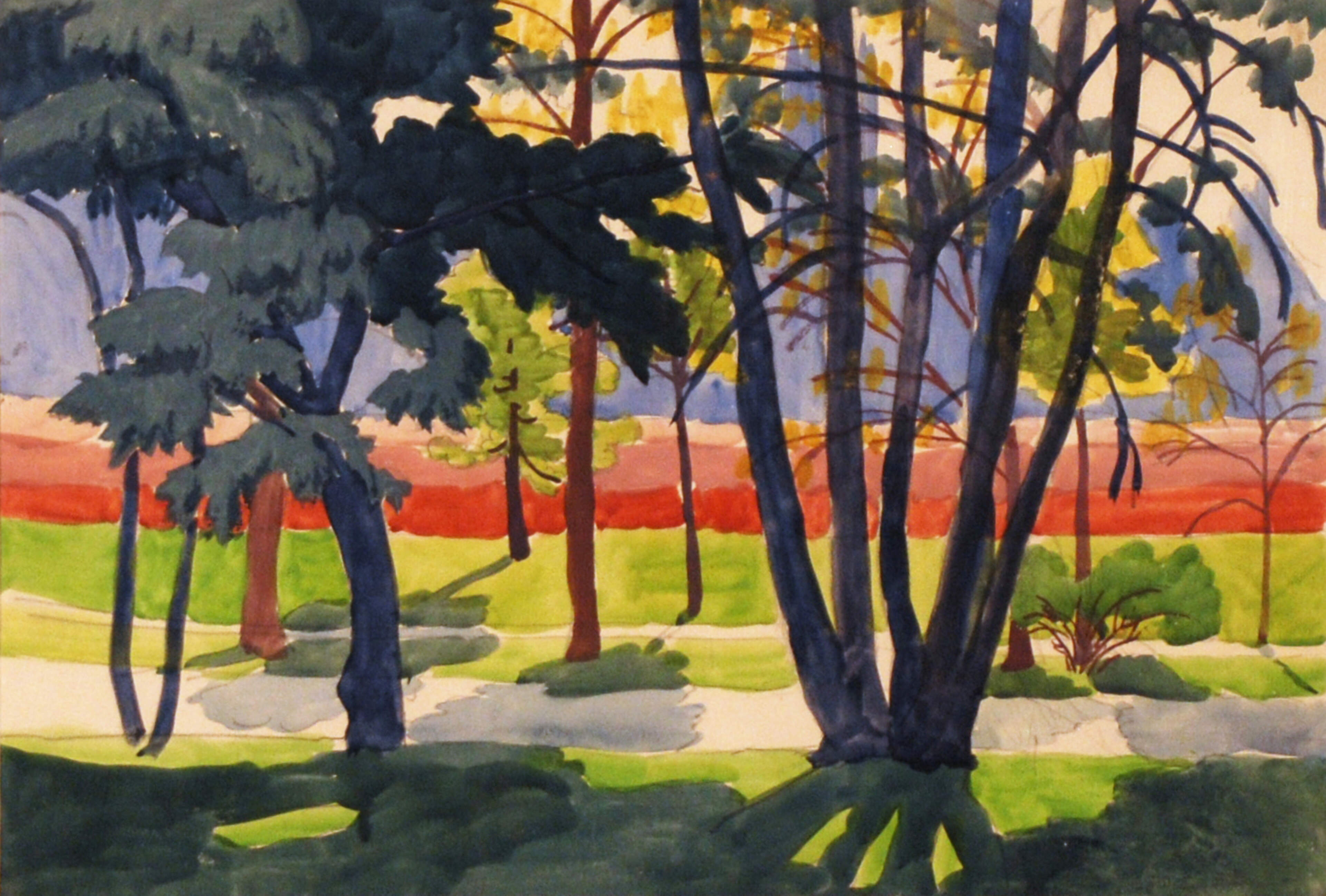
Charles E. Burchfield (1893-1967)Untitled (Clump of Purple Trees)
October 1915
Watercolor and graphite on paper
13 1/2 x 19 1/2 inches
Burchfield Penney Art Center, Gift of Tony Sisti, 1979
For his 1915 works, while still a student in the Cleveland School of Art, Burchfield "devised a simple formula" for laying color over a graphite drawing of the subject, which he described:
Everything was reduced to the twelve colors of the color wheel, plus black and white, with minimum modifications. Thus sunlit earth would be orange; shadows on it, red-violet; sunlit grass, yellow; shadows, blue or blue-green and so on. They were executed in flat pattern with little or no evidence of a third dimension.
This scene depicts Wade Park in Cleveland, Ohio, where Burchfield derived inspiration outside of class when he was attending the Cleveland School of Art. A Cleveland resident and Burchfield collector, S. Jay Ferrari, interpreted the shadowy contours in the background as Trinity Cathedral; Burchfield went to an organ recital there on January 6, 1914. However, William H. Robinson, Ph.D., who served at Curator of Modern European Painting and Sculpture at the Cleveland Museum of Art, identified the building as Amasa Stone Chapel on Euclid Avenue. See p. 85 in:
Robinson, William H. “Against the Grain: The Modernist Revolt.” In Transformations in Cleveland Art 1796-1946: Community and Diversity in Early Modern America, edited by William H. Robinson and Daniel Steinberg, 70-101. Cleveland, OH: Cleveland Museum of Art, 1996. (https://academic.csuohio.edu/tah/regional_arts/transformations/p70against.pdf)
(text by Nancy Weekly)